18.1 Understanding Automation
Automation is used to ensure that when your tracks are played, recorded changes in such parameters as volume level or panning can be recalled with the music in real time.
Kind: concept (user-guide-section) Chapter: 18 Automation – Envelopes and More Source: REAPER User Guide v7.70
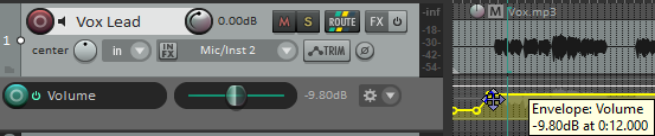
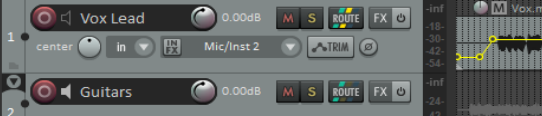
Automation is used to ensure that when your tracks are played, recorded changes in such parameters as volume level or panning can be recalled with the music in real time. At its simplest, for example, automation can lift the volume of a lead instrument during a particular break or passage, or add a little presence or warmth to the odd phrase here or there on a vocal track, to make it stand out in the mix a touch more. A simple example of an envelope (Volume) is shown here. The envelope here is displayed below the media item. The TCP shows an envelope panel with its own controls. When the track is played, its volume will rise and fall with the shape of the envelope. In the second example (below) the same envelope is displayed not in its own lane but on top of the media item. Both methods have their advantages and disadvantages. The first makes it easier to work with the envelope, but uses more space. The second takes up less space, but makes editing tasks that little bit trickier. How your envelopes are initially displayed will depend on your Editing Behavior, Envelope Display Preference Settings. You can change the display mode of any envelope any time with the context menu Show envelope in lane toggle command. REAPER features two main types of automation – one method uses envelopes alone, whilst the other uses a rather more complex (and powerful) technique known as parameter modulation. This chapter will deal with creating and using envelopes. Parameter modulation will be covered in Chapter 19.