The JS Loudness Meter
The display of parameter controls is turned on and off by clicking on the ? In the lower right hand corner.
Kind: concept (effect-summary) Source: REAPER Effects Summary Guide v3.04
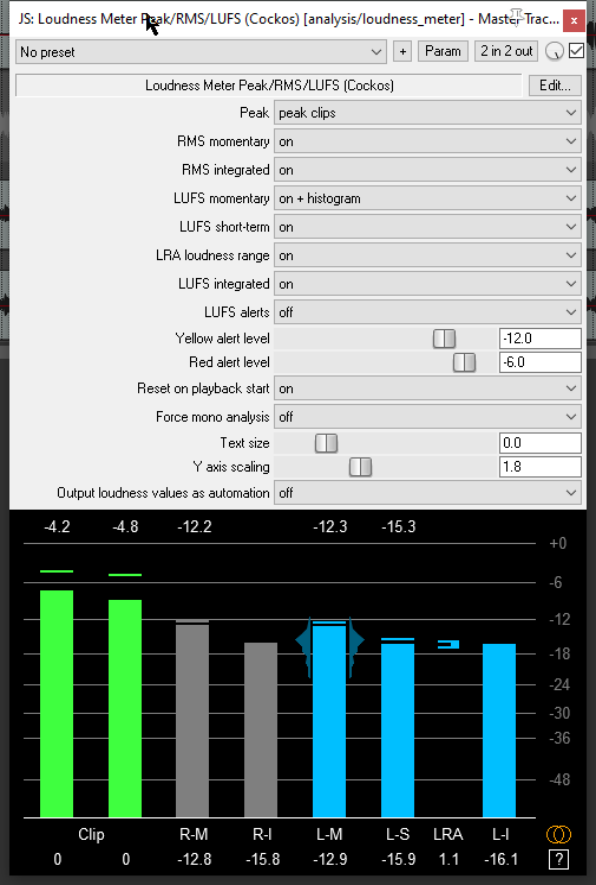
Note:
The display of parameter controls is turned on and off by clicking on the ? In the lower right hand corner.
If the entire window (controls and graphic display) is not visible you may need to resize the window, by clicking and dragging up from the top border or down from the bottom border.
The JS Loudness Meter displays visual feedback about LUFS (loudness unit full scale), RMS (root mean squared) and True Peak loudness. Insert it into any track or master just as you would any other plug in.
Before examining its parameters and controls in detail you will need to understand some technical terms, and in particular Peak and True Peak, RMS (Root Mean Squared) and LUFS (Loudness Units to Full Scale).
Peak: Highest actual level of the audio signal. Observing and controlling the peak is important to prevent distortion or clipping. Peak levels will change frequently and rapidly during a song – for example, when a cymbal is struck.
True peak: Highest level of the oversampled signal. Intended to estimate the highest level the signal could reach after resampling to any sample rate. You would generally expect this to be higher than the peak.
Root Mean Squared: This is a continuous average voltage measurement for electrical signals, usually measured at 300 ms. It offers a good indication of the average loudness of a track. As shown in the above illustration, RMS values can be expected to be lower than Peak levels and to fluctuate less dramatically. As a general rule, the greater the difference between Peaks and RMS the greater the dynamics.
Loudness Units referenced to Full Scale: The loudness of the digital signal, after applying filters intended to adjust for how humans perceive different frequencies. You can think of it, if you wish, in terms of the FletcherMunson equal reference contours: in brief, this takes into account that the human ear hear low and high frequencies less well than it hears mid range frequencies. These days LUFS is generally regarded as the preferred industry standard.
Now let’s examine these parameter controls …