7.3 The Routing Matrix
Let’s start with a look at the Routing Matrix for this project.
Kind: concept (reamix-section) Chapter: 7 Case Study 2: Pelverata Frost Source: ReaMix (October 2009)
Let’s start with a look at the Routing Matrix for this project.
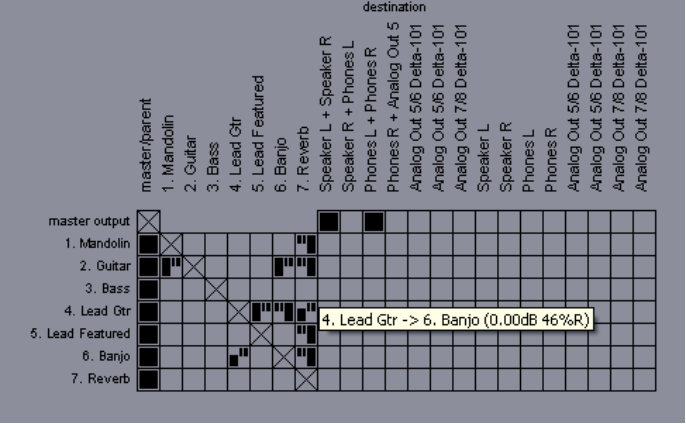
You can see that although this project contains only a small number of tracks, there are sends all over the place. You can hover your mouse over any of the intersections on the matrix (as shown above) to display a tooltip with information about that send.
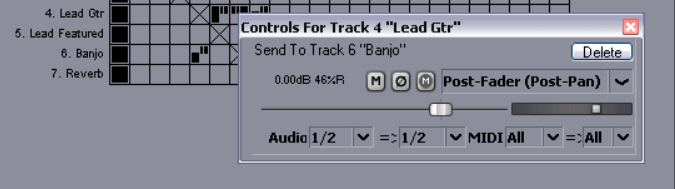
For more detailed information (or to make adjustments) you can of course right click over the intersection.
In overview, however, this project uses sends in four ways:
-
Track 7 is in effect a Reverb bus. Sends to this track from other tracks are used to add some reverb to each of those tracks. By adjusting the levels of individual sends, the amount of reverb added individually to each track is controlled. If you wish, you can also use the pan control on these sends to create a greater sense of width.
-
Sends from the Guitar to both Mandolin and Banjo are used to spread the guitar sound so that it occupies more width. This enables it to be given a strong enough role in the mix whilst at the same time keeping it towards the back.
-
Complementary sends from the Lead Guitar and Banjo (i.e., one from each to the other) are used to enable a fuller sound to be built as the song progresses. These sends are faded up gradually late into the song.
-
A send from the Lead Guitar to a separate track, Lead Featured, enable channel splitting techniques to be applied to this track to help it to stand out during a period of about 25 seconds when it is featured.
In the case of both 2. and 3. above, these are variations on the techniques of Bookend Panning and Shadow Panning. We have already experimented with both these techniques in earlier sections.